LoginNewsletters Videos Français

All posts by Brett Girard

Liberty November 2020 Update – What Happened in the Markets Over the Last Month

Hi folks. Brett Girard here, Portfolio Manager at Liberty, coming to you with another Liberty market update. This is for the month of November 2020.

It’s been a couple months since we’ve done one of these. We’ve been working on figuring out the right technology to use the videos and share with you, but I think we’ve landed on one now. It’s called Vidyard. Some technology out of Kitchener, so always nice to be using some Canadian content.

Let’s get started.

So first we’ll just get into a quick disclaimer.

***NOT SPOKEN***

The information presented herein is for informational purposes only and does not constitute financial, investment, tax, legal, or accounting advice nor does it constitute an offer or solicitation to buy or sell any securities referred to. Individual circumstances and current events are critical to sound investment planning; anyone wishing to act on this article should consult with his or her advisor. The information provided in this recording has been obtained from sources believed to be reliable and is believed to be accurate at the time of publishing, but we do not represent that it is accurate or complete and it should not be relied upon as such.

***

We want to make sure that we keep the lawyers happy and you’re more than welcome to read this, but the high level here is this is for informational purposes only. This is not investment advice, and if you do have any questions, please consult a qualified professional. Myself and the rest of the portfolio managers at Liberty would be happy to answer any of the questions that you do have.

So, 2020 in a nutshell. This is from January 1st through to November 30th. And, it’s quite the year. We can see the purple lines of NASDAQ, so that’s out in front in the lead with about a 40 percent return year to date. Next is the S&P 500, that blue line, up about 12 [percent]. The TSX is the orange line there, and it’s actually positive for the year, which is great. Below that, you can see the Dow Jones which is sort of that darker orange. And then struggling to make a positive return for 2020 is the Euro Stock 600. Still down about 5 percent for the year.

If we go into the next slide which you can see is specifically the performance over the last month. So, you’ll recall, it feels like a million years ago, but it was just the beginning of this month that—or I guess the beginning of last month now that it’s December 1st—the beginning of November when the election happened. And there’s still some items to be sorted out, but it looks like Joe Biden—who is the president-elect right now—will be the president in the oval office as of January. So, the market’s reacted positively to that.

And then also we had sort of the trifecta of vaccine information. So first it was Pfizer, then it was Moderna, and then AstraZeneca. All reported about 95 percent efficacies with their vaccines, so those have sort of been the wind in the sails of the market. And here, what you can see is actually the opposite of the year-to-date returns. The European numbers, the green index there, that’s actually done the best.

And this is something that, you know, it’s hard to do in the short term, but we really want our clients and our investors to think about this because we think about it all the time.

When something’s doing really well, there’s absolutely potential for momentum and for something to continue, but often times what we see in the market is the mean reversion.

So, Europe’s, again, compared to the other industries, not had a great year, but in the past month has bounced back in a big way. So, this is, you know, when you’re thinking about allocating capital, “If you can go to where,” as Wayne Gretsky says, “the puck hasn’t been yet. We’ll go to where the puck’s going to go.” And sometimes there’s opportunity to have a little bit of a lift.

We actually—throughout the back half of October into November—were buying European equities. And we’ve continued to do that here and there in people’s portfolios. So, this is just an opportunity that the market gives from time to time, and we want to take advantage of it when it does come up.

On the next slide here, I just want to touch on real quick. With respect to the performance of the NASDAQ and in particular the S&P, it’s really dominated by tech. And here, what you can see is that not all things gold can stay.

So, in 2000 between Microsoft, GE, Cisco, Intel, and Walmart, that was the largest five stocks as a component of the S&P, represented about 18 percent of the index. And over that time, you can see that there’s sort of a downward trend up until about 2016, where those large companies lost the percent weighting that they did have.

Now, in 2016, trends started accelerating and it was the FAANG stocks that had sort of moved upward. Today we’re in around 20 percent of the S&P, now being dominated by Microsoft, Apple, Amazon, Alphabet, Facebook.

So, what happens is this kind of hides the actual performance of the market. When you have these five names that all, as a matter of fact, sort of benefited from the work-from-home trend, and did well this year, it looks like the overall market’s doing well. But if you drill down that’s not the case; there’s not as much breadth. At least there wasn’t until sort of the middle of October. We’re starting to see more breadth come into the market now, which means there’s more performance across sectors. So, utilities are okay, retail is coming back, consumer is doing alright, hospitality looks like it’s coming back. And all of this is on the backs of, you know, the hope that the vaccine is going to change things.

But just a word of advice or a word of caution, you know, when you’re investing in these big stocks—the biggest market cap stocks that are out there—there’s a million eyeballs on them at all points in time. And sure, you can ride the trend up, but as we’ve seen time and time again, the largest companies do not always remain, right?

If you think back to 2013, the largest company was Exxon Mobile. They’ve lost about two-thirds of their value since 2013 in the face of—let’s call it pressure—around fossil fuels as well as weak energy prices. So just keep that in the back of your mind if you have too much exposure to any of these big names, it’s probably something worth trimming back and thinking more about.

What we’re going to try and do with these videos is also answer questions that we are getting a lot from clients or specifically the clients are writing in about. So, if you do have any questions, please feel free to write in. We’ll keep your name anonymous, but often times if you’re thinking something, other people are as well.

So, one of the big things that we’ve heard a lot this year is, “How can the market be up when the economy is struggling so much?” And it makes sense to just sort of lay out—a fully functioning economy has three different components that all contribute to its strength.

So, first is the consumers, two-thirds of GDP is consumer spending. So it’s you and I out there, going to restaurants, traveling, spending on clothes—all those things that we normally do and may not have been able to do as much during COVID. And part of that is really a function of consumer confidence. So, if you and I are confident about our jobs and confident of our future, we’re willing to open up our wallets and spend money. If there’s not a lot of consumer confidence, then maybe people would be less inclined to spend. And that has significant flowthrough effects into the economy.

The next pillar is business. So, businesses, you know, they create the goods and services that are consumed by the individuals like ourselves, as well as other businesses both domestically and abroad. So, it’s an important component of GDP and then GNP, which is sort of looking at how a country is doing in terms of trade around the world.

And then the third pillar is government, right? Government’s supposed to be a redistribution mechanism where taking taxes from certain groups or certain companies, people, things like that, and then redistributing them to potential areas that need it more. They’re also intending to be, or intended to be a backstop for businesses and consumers in tough times.

So, when we think of the economy, like, yes, there’s definitely some struggles this year. The consumer is hurting. That’s sort of apparent if we look around and see the businesses that are shut down and things like that. From a—and this is a chart from the St. Louis Fed—here we can see unemployment. So, through coronavirus, we got up to about 15% unemployment in the U.S., it’s now down to seven and a half [percent]. Which is half as bad as it was in March, but still about double where we were from an unemployment perspective at the beginning of the year.

So, there’s a long way to go, and consumer again, and consumers are hurting from actual spending perspective, but then from a consumer confidence perspective. Because if your job is at risk, you might not be willing to spend and stimulate the economy.

Next, we can look at corporations. So here, we have the orange line, which is the most important, and this is corporate profits after tax. Here you can see if you look back in the financial crisis, there was a big drop at this—scale is not that strong—but in 1987 as well as 1974 there were drops. And obviously, here in COVID there is a big drop in corporate after-tax profits.

So that’s something to be aware of, and it’s really something that’s causing a concern in the market because what’s happening is corporate profits are dropping, but stock prices go higher. And what that means is valuations are becoming more and more rich, right? You’re having price to earnings multiples, and price to sales multiples grow, which as we know, again with that mean reversion, they cannot grow forever. So, we just need to be cognizant of what our dollars are being invested in, and what the underlying economics of those companies are like.

And so, you know, the consumer’s hurting, corporations are hurting, and how are we chugging along? How is the market doing what it’s doing?

Well, really here, this kind of is the one picture that speaks a thousand words. You can see the S&P index is that red line and then the blue line, which looks like it tracks very closely—and in our view’s not even a correlation, but actually a causation—it’s the central bank balance sheets from around the world. So here we’re plotting the dollars that the Fed in the U.S., the ECB in Europe, and the BOJ in Japan have injected into the market. And there’s a pretty close relationship between how the balance sheet has expanded, and how the stock market has gone up. This is something that we have to keep an eye on though because balance sheet expansion is not free. It comes at a cost as governments put more money in, they have to borrow more money. While interest rates are low, they can cover their borrowing costs just like you and I, but at some point, if interest rates do start to back up, then it’s going to be very significant costs on the backs of the governments, which is going to flow through and impact the social programs and other spending the governments can do.

So just an interesting chart. We’ll have to continue to keep our eye on this going forward. And you know, closer to home here in Canada, the Liberals unveiled a hundred-billion-dollar stimulus plan. It’s going to push 2020s deficit somewhere between 380 and 400 billion, and it puts our federal debt at more than 50 percent of GDP. So that’s a risky area. You know, you can understand the government’s position in the sense that they have to stimulate, and they have to get the country through this lockdown. We understand that, but we’re just saying that it’s not without consequence. When you stimulate this much and when you put all this money into the system, eventually you have to pay for it. You know, as David always says, “Debt doesn’t disappear.” And this is government debt which is going to have to get paid off either through higher taxes, through less social support, or some other mechanism that we’ll have to see what they come up with next.

So another question that we’ve been getting from the clients across the board is really, “What are you expecting in the stock market next month?” We’ve had sort of, you know, a really interesting 11 months, what’s the twelfth month of the year going to look like?

And from our perspective, you know, I think the thing to expect is volatility. And we’ve seen volatility throughout the year, but in particular, we’re going to see less liquidity, so less people are going to be trading as they start to go into the holiday season. Some people are going to take their gains and shut it down for the year. So, when you have less supply and less demand in the market, it can mean that prices can move more than they otherwise would.

We’ll probably see some rebalancing. So, what that means is that the stocks that have done really well, oftentimes from a risk perspective, investment managers will decrease the weightings of those. So stocks that have gone, you know, have had good years, will see some selling pressure as people try to take some of their gains. The flip side is we might see some tax-loss selling. So there, the stocks have done really bad, we might actually see even more pressure because people are saying, “Let me take this capital loss, and on Canada gains potentially some of my capital gains for the year.

One of the other trends that tends to happen in December is what’s called the “Santa Claus rally.” So, from our perspective, because you know we’re not trading the portfolio, this is really just window dressing. And with window dressing, what the portfolio manager is doing is they’re saying, “I didn’t hold a stock that’s done really well this year but let me put it into my portfolio so that when I report at the end of December, it looks like I’ve been smart, and I’ve been holding this company along the way.”

The other thing I think is that Congress is potentially going to pass some sort of stimulus bill before the end of the month. There seems like  some bipartisan conversation right now between the US between the Republicans and the Democrats, but the chances are it’s going to be more of a skinny bill which wouldn’t be as much stimulus as the Democrats potentially want. So that could have some impact in the market given the sort of correlation between government stimulus and what the S&P 500 has done.

At the end of the day, what we’re going to do is what we’ve been doing all year. We’re going to look for opportunities where there’s mispricing and potentially pull the trigger to increase our allocation to stocks that are trading, you know, below what we think is the fair value. But at the same time, we still want to hold a bunch of cash because getting into 2021—even if Joe Biden gets in—there’s still a lot of work, right? He’s not going to be able to flick a switch and change things dramatically, and the same goes for the vaccine. There will be vaccines coming, but it’s probably not going to be something that happens in the first quarter of the year. So, there is light at the end of the tunnel, but probably still some bumps along the way. And that’s why we wanted to have cash—to take advantage of any short-term opportunity.

As always, thank you very much for tuning in. We really appreciate you taking the time to do so, and if you have any questions, please reach out to myself, David, or Annie. Take care, bye-bye.

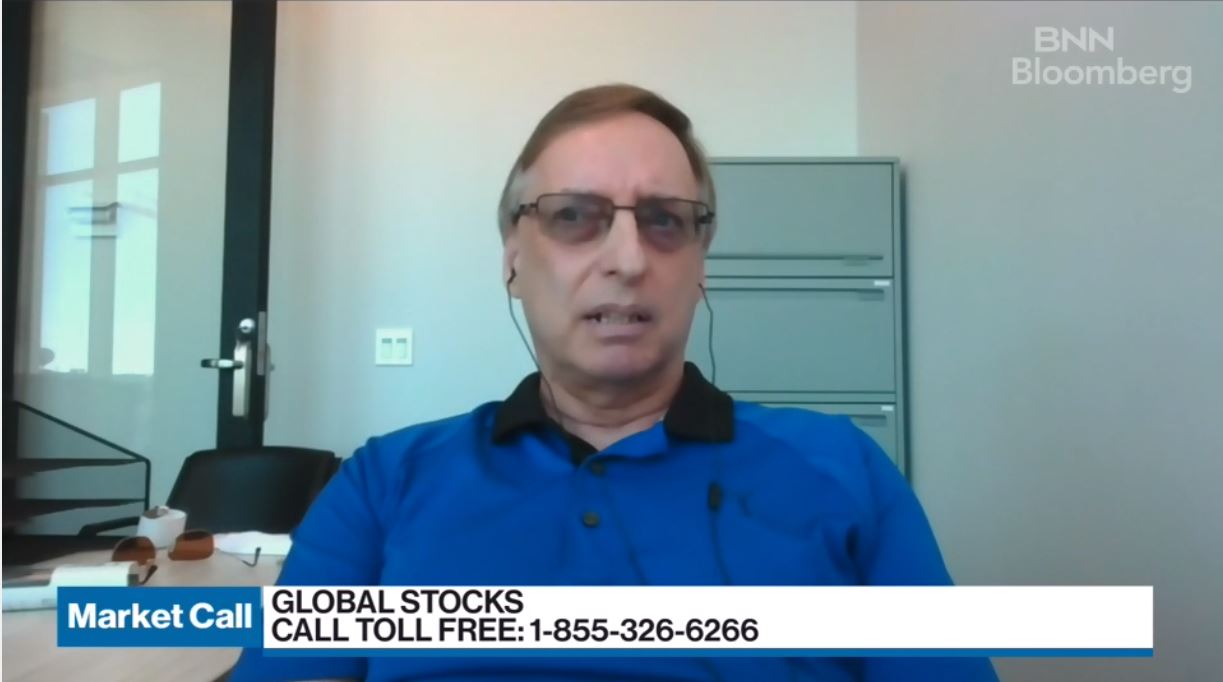
BNN Bloomberg Market Call – September 16, 2020 – Market Outlook

market call video thumbnail

[Text Intro]

ANDREW BELL: Hi there. Welcome to Market Call. It’s going to Brett Girard of Liberty International Investment Management. He’ll take your questions on global stocks. 1-855-326-6266. Email us: marketcall@bnnbloomberg.ca – Just remember, the topic is Global Stocks Today. Always love that. Takes us around the world, talk about companies sometimes that you never really hear much about. Let’s check in on the markets though, before we get going with Brett Girard.

We have seen southern Nasdaq down a bit earlier. As of this morning, it was down around 5% already in September. Now the Nasdaq in later trading did turn up a bit. We sold up around 13 points. S&P 500 up around 18 points, last time I looked. The TSX 300 rallying a bit as well, around 35 points. So we have seen something of a turnaround in the Nasdaq and a generally positive tone for the other big industries.

We are joined now by Brett Girard of Liberty International. Brett, it’s great to talk to you. Global stocks obviously trading on the mana of—mana from heaven of low-interest rates. A sugar high depending on how you want to look at it. Are we headed for a fall, ultimately? Is this just an artificially inflated market?

BRETT GIRARD: Yeah, thanks for having me back, Andy. So, I think it’s important for us to not just look at today, but let’s look at the whole year, right? Let’s rewind back eight and half months, and if we go back to January, we started off the year quite strong. Between January and the middle of February, we were up about 5%. COVID was something that was happening in China and wasn’t really a North American or European issue. But then from there, it obviously did spread. And that brought the market down by about 35%, and that’s the fastest drop that we’ve seen on record in the shortest amount of time.

But from there, the central government, or the central banks and the governments around the world, they stepped up, and—through a very coordinated fashion with both monetary and fiscal policy—they moved a ton of stimulus into the market. And that brought us from our March 23 lows up 61% to the beginning of September to the beginning of this month.

Now since then, as you sort of said, we’ve started to teeter, and maybe a little bit of wind has come out of our sails. But we’re still, y’know, we’ve fallen 5% since the beginning of September, but if you look over the course of the whole year, we’re up about 7% when we look at the S&P from when we started.

So that’s where we are, but I think it’s important for investors to remember that we’re by no means out of the woods, right? If you think about what’s still in front of us and the headwind we still have to deal with—there’s no vaccine, right? We have a lot of noise and a lot of this and that, but nothing clear in terms of something that people can take to prevent this from happening. And at the same measure, y’know, no real treatment. There’s no clear communication from the governments in terms of what stimulus is going to look like over the long term, in terms of how much and how long, uh, it’s going to last for.

And then politically, you know, more broadly, we have the threat of an election here in Canada. In the US, we have an election that’s now less than 50 days away and is going to be potentially hotly contested. And then, within the stock market, valuations are quite high. Y’know, especially in certain sectors—and I’m sure we’ll get into that today—but then, just to top it all off (as if that wasn’t enough), we’re seeing instances of rampant speculation in certain pockets of the market. So there’s, y’know, as investors out there, you should be happy if you’re even or if you’re up a little bit this year. But like I said, we’re not out of the woods, and the next 6 to 18 months are going to be very critical for preserving capital. That’s really what people at home should have on their minds.

And from our perspective, there’s kind of three things to think about in terms of preserving capital. So one, y’know, forward returns are really a function of what you pay. So if you’re paying and you’re getting in at an all-time high, or you’re getting it in at a high price, that’s going to impact the returns that you can have over a period of time.

The second thing is that I think investors need to try to use time to their advantage. So if you’re in and out of the market trying to day trade, or use options that have a close expiration, time is working against you. If you’re trying to invest in a company and hold that company for a long period of time, then time and compounding are going to work with you.

And the last thing that I would just say is, y’know, it’s great to sort of watch the market go higher and higher. But if things do come off—and we’ve seen volatility throughout this year—if you don’t have cash that you’re sitting on, you can’t take advantage of these opportunities, right? So I would encourage people at home to have some cash on the sidelines so that if we do get a bigger blowup in September or October—y’know, any time in really like I said, the next 6 to 18 months—then they have the funds to take advantage of that. And the other thing with that cash is you should have a wishlist, right? You should think about these are the 5 or 10 companies I wanna buy, and when the price gets attractive, that’s when I’ll buy them. Not today at all-time highs.

ANDREW BELL: Mmhm. We’ll take a break. Brett Girard is taking your questions on global equities: 1-855-326-6266.

Liberty YouTube Video – June 2020

[Text Intro]

Hi folks, Brett Girard here with another Liberty Market Update. In our last video, we discussed how the stock market was pricing in Goldilocks Recovery of the economy. Although there may have been a few bumps along the way, this continues to be the case, at least for now.

The number one contributor to the stock market rally has been government intervention, through both monetary and fiscal stimulus. Over the last two months, this stimulus has been an invisible hand holding the economy together through both the closing and reopening. Now just to refresh, monetary stimulus is achieved primarily through two different means: interest rates and balance sheet expansion.

When trying to stimulate the economy, interest rates can be reduced. This pulls forward economic activity by encouraging borrowing through lower interest costs. Another mechanism for monetary intervention is through balance sheet expansion. There’s something called open market operations the Federal Reserve can purchase securities off the open market, and by doing so, inject cash into the financial system.

During this crisis, we’ve seen both interest rate and open market action. Coming into 2020, interest rates were already at historic lows. However, as the COVID crisis hit back in March, the Federal Reserve dropped the overnight rate down to zero. In the past, this has been quite stimulative for the stock market, but this time around, when rates fell to zero, we actually saw the stock market fall. This signaled that there needed to be more stimulus from a monetary perspective.

At that point, the Federal Reserve began to purchase securities—namely bonds—in order to keep the wheels of the economy turning. The size and scope of these purchases have been unprecedented and played a big part in the recovery of theS&P 500 over the last ten weeks. Let’s take a look at some charts.

This chart comes to us courtesy of Bloomberg. Let’s orient ourselves for a second before we get into the data.

Along the X-axis at the bottom, you can see we’re looking at the years 2009 through to 2020. 2009, as you recall, was the end of the last financial crisis, so this is mostly an expansionary time that we’re looking at here on the graph.

On the left-hand side, you can see the numbers 100 up to 350. This maps to that orange line, which is representative of the S&P 500. So that 350 is actually 3,500, which was just above the all-time top of the S&P 500, which we saw in February of 2020.

The white line maps to the right-hand axis. Here you can see 2M at the bottom, right? Up to 7M at the top right. This represents the number of dollars in trillions that the federal reserve on their balance sheet.

So beginning back in 2009, the S&P 500 and the Federal Reserve Balance Sheet moved in tandem through all the way to the middle of 2016. At that point, there was measures taken to reduce the size of the Federal Reserve Balance Sheet. And you can see there that the white line falls towards the bottom right through 2017, 2018, and into 2019.

At the same time, the S&P (that orange line) continues upwards through 2017, through 2018, and through 2019, until we have the correction of the recession that we’re in right now happening in 2020. Now there we can see a steep drop in the orange line (the S&P 500) followed by an increase in the white line (the size of the Federal Reserve Balance Sheet).

So what this shows is that we actually moved from about 4 trillion on the balance sheet through to 7 trillion in very short order. And it’s no surprise that as the balance sheet expanded, the S&P recovered, and this is where we start to see the beginning of that V-shape (the orange) back up to a level of about 3,000. And we’re a little higher today, but that’s where we are on the S&P. There’s a very tight relationship here, and it’s important to next look at how this relates to P/E ratios of the S&P 500.

This is another graph courtesy of Bloomberg. Again, let’s take a second and orient ourselves.

On the left-hand side, represented by the yellow line, what we can see is the size of the Federal Reserve Balance Sheet. In the bottom left, we have 1 trillion, up to 7.165 trillion on the top. On the right-hand side, represented by the white line, we can see not the price of the S&P 500 but the P/E ratio. Which, P/E, if you remember, stands for Price to Earnings—this is a valuation metric that tells us how expensive the market is. So there, at the bottom right, we can see a value of 10. That means you’ll need to pay a price of $10 for every $1 of earnings. And up to the top, you can see a value of 24.83, so here you’d be paying $24.83 for $1 of earnings. Now all things equal, you’d much rather pay a lower amount or have a lower valuation when you’re purchasing a stock.

As you can see from 2008 through to 2020, as the Federal Reserve Balance Sheet expanded, so too did the valuation of stocks in the S&P 500. In other words, they got more expensive. This trend really took off in 2020 where we can see the white line and the yellow line accelerating together, in tandem, from a P/E ratio of 18 (which is on a historical perspective, quite expensive), up to 24.83 (which is very expensive historically), as you’ll see in the next chart.

One last chart from Bianca Research provides some historical context on how expensive stocks are today. The blue line represents the S&P 500 Price to Earnings ratio since 1995. In this chart, we can again see the rapid rise in P/E through 2020 up to a rating of 25.4.

As discussed, this was due to the Federal Reserve Balance Sheet Expansion, but also the fact that earnings literally fell off a cliff as the governments around the world imposed their lockdown. It’s yet to be seen how earnings will recover, but it’s important to note that over the last 25 years, the current valuations are second only to the Dotcom Bubble—that peak you can see on the left side of the graph.

At that time, the P/E touched 27 in the last days of 1998. If you recall, the fallout from this rise in the Nasdaq was an 80% drop from peak to trough.

Turning to the economy, we’re quite concerned about the employment situation. This chart shows non-farm payrolls since 2014. Though the market’s rallied on the news 2.5 million jobs being added in May (you’ll see that slight up-tick in the bottom right), one look at this chart shows that in 2 months we dropped from well over 150 million employed people to just over 130 million. And really, there’s a long way to go in this V-shaped recovery. Double-digit unemployment has a significant impact on personal consumption, which at last check, makes up about 70% of GDP.

The biggest question going forward—as graphically displayed in a recent Bloomberg article—is what if, in flattening the curve around COVID, we created two curves of unemployment? The first sharp yellow shaded peak on the left will be the people that will return to their jobs as the lockdown is lifted. The lower, wider blue-shaded peak on the right is the collateral damage of businesses not making it through the lockdown and resulting in more permanent job losses. This could be the scar-tissues from the last couple of months that we’ll have to contend with for years to come.

And yet, in spite of all this bad news, the market continues to rally. This is where risk management comes into play. On the valuation space, the price to earnings were in the top 10% of what we’ve ever seen historically. That means that, statistically, unless earnings stage a meaningful comeback, we could only expect a 10% chance of going higher from here.

While not impossible, our questions remain. Is this runup in prices sustainable? What happens if the Federal Reserve stops or if the market views all of a sudden the stimulus to be insufficient? What happens if some of the lockdown job losses are other than temporary? And how does the economy function with double-digit employment?

It’s only going to be in the fullness of time that we’ll find out the questions and more. So, for the most part, we will remain with our asset allocations, as we’ve discussed. You’ll still continue to own your equities and participate in any further rally, your fixed income will continue to provide income (especially the longer-dated, higher-yield names in your portfolio), and the cash that you have will continue to collect nominal interest as we patiently observe the market and wait for an entry point.

As always, please feel free to reach out to David, Annie, or myself, as we’re always available to chat. Thank you, and take care.

Liberty YouTube Video – May 11, 2020

liberty iim banner

Hi folks. Brett Girard, Portfolio Manager at Liberty here for another market update.

As we enter the second full week of May, the S&P 500 is staying around 2,900. This is about 15% lower than the peak in February and about 33% higher than the most recent market bottom in March. To get back to those February highs, we need to see another 17% rise.

Now, all said, we’ve had quite the run over the last seven weeks. The big question you might be asking is, why? It’s a very good question, and to answer that, we have to go back to the basics on what stock represents.

When purchasing a stock—which is really an ownership stake in a business—you’re buying claim to all future gains and losses of the company. The keyword there is future. Imagine investing in a stock—or more broadly, in a stock market—sort of like driving in a coal-fired, steam-powered train. The future is visible, but only at the front windshield, and you’re stuck on the tracks with only the ability to speed up or slow down. And to successfully operate the train due to its size and weight, you must look well into the future so that you can react in advance of when you need to. You don’t want to drive too fast because you run the risk of coming off the rails, but you also don’t want to drive too slow because you run the risk of the weight of the train overcoming the power of the engine and causing it to stop.

This current health and economic crisis could very much cause the train to stop. But the market’s focused on three things, all of which are positive and giving the impression that we’ll be able to maintain speed going forward.

The first thing is fiscal and monetary stimulus. By effectively taking interest rates to zero and lending money to corporations of all sizes, the governments of the world have—in a very coordinated fashion—shoveled coal into the engines of the train. It’s unclear how much coal the train is carrying, and therefore how much more stimulus is possible. But the market’s pricing that the stimulus will avoid partisan issues and continue until it’s no longer required. Think of this more like enough coal to power the train and to maintain our current speed.

The second force propelling the train is the reopening of the economy. Now, shelter in place orders are being lifted around the world. In China, parts of Europe, and even in certain US states. With that, there’s a wave of hope akin to a tailwind pushing the train. The market is pricing that regions around the world will continue to reopen, and behaviors will revert to pre-lockdown patterns. That means that people will fly on planes, people will eat out, and purchasing habits will not change fundamentally from February. In other words, the tailwinds pushing the trains will continue.

The third force propelling the train is that some sort of COVID-19 treatment or vaccine is just around the corner. There are currently almost 100 clinical trials in the US alone of some of the brightest minds in medicine and science toiling away. A development in this area would be significant for the economy and the markets. You can think of this as a sort of change in the pitch of the tracks, where the train can now head downhill with gravity’s help. It’s a lot easier to travel on the train in that case.

Now, this all sounds great, but we have to remember that trains, unlike cars or planes, are stuck on the tracks with only the ability to speed up and slow down. That means that any obstacles in the way, hazards, cannot be avoided.

From where we sit at Liberty, there are three big hazards related to the rosie view just presented.

First of all, regarding the Federal Government Stimulus, we want to know what happens if it slows too quickly or just stops outright. With respect to monetary stimulus, while lower interest rates appears to be the new norm, the Federal Reserve has already made monetary policy changes by scaling back open market operations. This is a signal to the market that the stimulus is not intended to exist in perpetuity.

Our eyes run the fiscal stimulus, not only for the large and small businesses but also for the furloughed or the laid-off individuals. With reports of people making more money by staying home and collecting government checks than they were while they were working, we wonder how the train is going to keep chugging if the stimulus (or the coal in this case) stops being shoveled into the furnace.

Now, if you’ll permit, I’ll mix metaphors for a second. The stimulus represents life support for a very sick person. It helps keep them alive by supporting their breathing and by administering fluids. But what happens to a sick person when they come off life support? Will they able to function on their own? Will the economy? If recent history is any indication, just think back to 2018 (specifically in the fall) when the Federal Reserve attempted to increase interest rates. We all remember the S&P fell by 20% during the last three months of the year. Is that what we have to look forward to?

In terms of reopening, significant economic damage has already been done. Over the weekend, the University of Chicago released a paper estimating that 42% of businesses (most of them were small businesses) won’t be able to reopen once the economy does. Unemployment in the US increased by 20 million people in April alone, and there’s expectations that the unemployment rate could eclipse 20% during May.

Here at home, we’ve lost about 3 million jobs, and the Canadian unemployment rate as of the end of April sits at 13%. Now, some of these job losses will be temporary, but as we reopen, we’ll have to contend with the reality that certain people will have permanently lost their jobs.

Across the board, we’re seeing savings rates increase as people are more focused on saving for rainy day funds than consumption. And really, I don’t think this is being talked about enough; just because a business reopens doesn’t mean those scared will be willing to go out in public. When you step back and consider that 70% of economic activities predicated on consumer spending, reopening won’t get us very far unless individuals have the funds and the desire to spend. This could be a significant headwind for our train for years to come as job creation does not happen overnight.

While much is being done in terms of researching a treatment and a vaccine for the virus, the truth is we have a long way to go. Medical experts throughout the world are working on the hypothesis that the earliest we could potentially see a breakthrough is 2021.

In the meantime, we’re concerned about a second wave of COVID erasing the gains we’ve made in flattening the curve. Not that the Spanish Flu of 1918 is a perfect analog, but death rates were far higher during the fall of that year, which coincided with a second wave after a relatively mild summer. This is a hill that the train must climb, and it’s going to take great time and energy to reach the apex.

So, you might be asking, what are we doing at Liberty? Well, our activities could be summed up in two words: we’re observing, and we’re preparing.

The equities that you hold were selected based on the strength of their balance sheet, the ability of their companies to generate free cash flow, and the aptitude of their management teams. It’s in times like these—in these economic stressful times—when we see how well strong companies can perform. We’ve always shied away from the cyclical travel, restaurant, and energy stocks because our goal is to consistently grow free cash flow over time, not do so in booms and busts.

Consider yourself: while you might be deferring the trip around the world or not filling up your car with gas, we’ll hazard a guess that you’re still continuing to purchase your soap (from a company like Unilever), taking your prescriptions (maybe Novo Nordisk), and staying connected through your cell phone (like at Tellus). Some things won’t change, and that’s why we’re happy with the equity holdings.

In some portfolios, to maintain proper asset mix, we’ve selectively made purchases on the fixed income side. Both corporate bonds and preferred shares issued by high-quality companies have been snapped up as institutional players a step behind are just now trying to raise cash.

Finally, the cash balance that you’ve had in your accounts since 2018 is still there. It will remain until your stock holdings hit our pre-determined prices. This is anywhere from 40-60% below where we are currently trading, as mentioned in the newsletter. Ultimately, equity valuations are very rich from a historical perspective, so we are patiently waiting.

While each week of shelter in place feels like a month or even a year, we’re only ten weeks into this recession. And if history is any indication, that means another 20 months on these tracks before the economy recovers.

As always, please feel free to reach out to David, Annie, or myself for any questions. We’re always around to chat. Thank you for watching, and please take care.

BNN Bloomberg – Market Call – April 1 2020 – Top Picks


MARKET OUTLOOK

We are in unprecedented times, with the combination of zero or near-zero interest rates, historically high corporate and government debt and COVID-19 lockdowns throughout the world. Despite this, the stock market has rallied materially from the lows last Monday. Our concern is the demand destruction on the consumer side, as this accounts for two thirds of GDP and was an important catalyst in propelling the great bull market of 2009-2020.

Through this volatility, our game plan has remained: 1) maintain a diversified portfolio of high-quality, well managed companies that have the free cash flow and balance sheet to keep the lights on and the doors open; 2) don’t be afraid to hold cash; and 3) maintain weightings across and within asset classes.

TOP PICKS

UNILEVER (UL NYSE)
Most recent purchase on March 5 at US$56.76.

Unilever is a defensive and global consumer staple with operations in 190 countries and over 2.5 billion customers worldwide. Business lines are almost equally split across food/drink (Hellman’s), home care (Sunlight) and beauty care (Dove Soap). Geography is evenly split across developed and emerging economies. The dividend has grown by just under 10 per cent over the last 10 years and is currently yielding about 4 per cent.

TELUS (T TSX)
Most recent purchase on March 5 at $51.21.

Connectivity is essential today, especially considering the number of those working from home. Telus grew both wireless and wireline segments through the Financial Crisis. It issued $1.5 billion in stock at a split adjusted price of $26 in February. Get paid to wait, with a dividend yield over 4.5 per cent.

CASH

Sell-side banks continue to call for V-shaped recovery with Q2 GDP to fall by over 25 per cent before recovering sharply in Q3 to finish the year at low negative single-digit GDP growth. Investors should consider holding cash to opportunistically purchase quality names if the demand does not immediately return and recovery is more prolonged than expected.


DISCLOSURE PERSONAL FAMILY PORTFOLIO/FUND
UL Y Y Y
T Y Y Y


Liberty YouTube Video – March 25, 2020

March 25th Liberty Market Update – How the Covid-19 health crisis turned into an economic crisis and ultimately a financial crisis.

[Text Intro: Liberty International Investment Management. The freedom to create your future.]

Brett Girard: Hi folks. Brett Girard here, portfolio manager at Liberty coming to you with a market update.

Now, normally we reserve these market updates for our quarterly newsletter, but there’s so much happening in the world today we thought we could put this out as a sneak peek.

In the news, increasingly we’re hearing stories of how the events of today are similar to the dot com bubble and the 2008 global financial crisis. I’m going to go out on a limb here and say the most dangerous four words in finance. This time is different! Sort of.

See, if you look back to dot com and you look at 2008, what happened in both cases is that we had a financial crisis turn into an economic crisis that then fed back into a financial crisis creating a negative feedback loop causing markets to lose a substantial amount of value.

In both cases, what happened was, asset prices ticked higher and higher. In the case of dot com, it was the tech stocks, while as in 2008, it was real estate. In each instance, what happened was a “Minsky Moment.” Now, this is an economic term whereby everything’s okay until it isn’t.

This usually happens when the next buyer decides that the price of an asset is too high and doesn’t commit. So, in the case of tech stocks, cause remember Microsoft or Cisco looked as though they were going to go on forever—they didn’t. That last buyer did not show up. And that’s when the market started to realize that these companies were very overvalued.

Same thing happened with real estate back in 2008. There was lending to people that didn’t have jobs, didn’t have credit, and eventually, some smart minds came to the table and said these people aren’t going to be able to pay for their mortgages. In both cases, the financial crisis out of the high-valued asset precipitated into an economic crisis.

Now today, things are a little different. With today what we’re experiencing is a health crisis as a result of COVID-19. This health crisis has caused an economic crisis, as you can see in the news in terms of the unemployment reports here in Canada as well as the US, and then more generally abroad, as every country locks down in an effort to quell the spread of the virus. And from that what we’re expecting to see is a financial crisis in the next quarter to two or three quarters.

Now, let’s get started with a health crisis. Here’s the data on COVID-19 as of March 25th, 2020.

[World map on screen: Coronavirus COVID-19 Global Cases by the Center for Systems Science and Engineering (CSSE) at Johns Hopkins University]

Now we won’t spend long on this data because you’ve probably seen this reported in the nightly news. What’s in front of you is information from Johns Hopkins University in Baltimore. On the left-hand side, we can see total confirmed cases. Here China represents about 20% of the total confirmed cases in the world. This has changed dramatically since the virus was first reported in late December, early January. What we can see, unfortunately, is that Italy and the US are catching up, and the way the projections are looking today, they’re going to bypass China sometime in the next week.

On the right-hand side, we can see total deaths is just under 20,000. Unfortunately, here again, we’re likely to see this number tick higher. Although, there’s been reports that are coming out of Italy that the rate of change for the number of people passing away is declining. And that’s an indication that potentially the viral load has peaked there. We’re going to be waiting for that to happen in the US, but it appears based on the data coming out of New York that there’s still going to be some time before we hit a point where the rate of people passing away will decline on a day-to-day basis.

In the meantime, it’s important that we all stay safe, follow the rules of our governments. If we are supposed to be locked down, let’s stay locked down, and let’s do our part to help.

Moving on from the health crisis, let’s look at the economic impact. Unfortunately, it now appears a global recession is unavoidable. The real debate is around how long and how severe this recession will be. Here at home, there are a number of reports coming in this morning that unemployment in Canada could be as high as one million in the next week.

Anecdotally, in Ohio, claims for unemployment insurance went from 4,800 two weeks ago to 139,000 last week. Now multiply that by 50 states, and the number of unemployed people could be in the millions. Really a staggering number. St. Louis Fed President Jim Bullard went on the record Sunday and estimated that at the peak, we could see US unemployment hit 30% and US GDP fall by as much as 50%. Further, in India, the country’s 1.3 billion people have been locked down for the next 21 days.

Let’s be clear. Economies cannot function when people are at home and away from work. Now, in response to everything that’s happened economically, federal governments have been coming to the table. There’s a silver lining in all of this. The G7 governments have not been caught totally flat-footed like we saw in 2008. In fact, a lot of these countries are taking out their 2008 playbooks, dusting it off, and trying to put things to work.

Well, initially, we thought that COVID-19 was going to be a problem for just China. Once the physicians in North America and Europe started to ring the alarm bell, governments did start to mobilize. Somewhat slowly, but we are seeing progress. In fact, in the US, interest rates were cut two weeks ago down to zero, and the Federal Reserve committed to making an unlimited number of securities purchases.

These purchases will alleviate the strain on the banks and hopefully keep the economy functioning. Yesterday, the US Senate passed a bill that allowed two trillion dollars to be committed in aid over the upcoming months. It’s unclear exactly where that two trillion is going to go, we are still waiting on details, but that’s going to have a significant impact helping businesses and people get through this crisis.

Canada’s also doing its part, and there have been some packages proposed. It’s yet again for details to emerge, but we are watching and waiting to see that. As we saw in 2008, TARP with the banks and TALF for the asset-backed securities, there are a number of programs that did come out from the government, and not one silver bullet does emerge. Rather, it’s a function of different programs at different times, released to really help out businesses and individuals. And the goal through all this is to get confidence back in the minds of people running businesses and people working at businesses. Once we have confidence return and combine that with the fact that the health risk has decreased and allowing us to go outside, I think we’ll see a corner be turned on this current crisis.

Now, we’ve talked about health, we’ve talked about the economy, but how does that translate to you, and how does that look from a financial perspective? Let’s look at some charts.

[Chart on screen- Looking for a bottom: stocks held onto small gains Wednesday after a prolonged selloff.]

The first of the three charts, courtesy of CNBC, displayed is the S&P 500 over the last six months. Just a note, we use the S&P 500 as our equity benchmark because it represents the 500 largest companies in the US, most of which have operations around the world. This index is much more representative of the broader economy than the DOW, which only has 30 companies, and the TSX, which is dominated by resources and financials.

You’ll note from peak on February 19th, the S&P fell from 3,393 to 2,191 for a total peak to trough drop of 35%. Now technically, we enter a bear market with a fall of more than 20%, so we are well through that threshold. While we did not anticipate the one-two punch of COVID-19, and oil price wars between Russia and Saudi Arabia, our view at Liberty was that systematic risk in the markets throughout 2019 and into 2020 warranted a significant cash position. Our reduced equity exposure as a result of this cash position, along with our bonds and the falling Canadian dollar, have meant that our client portfolios have been impacted but nowhere near close to the extent of the broader stock market.

Now, on this graph, you’ll see a yellowish line. That represents the 200-day moving average. This is a technical indicator that is used to help determine the general market trend. While we are still and will always be dyed-in-the-wool fundamental analysts, it’s helpful for us to use the moving average as a tool to see how negative the trend has been. Since bottoming on Monday, the S&P has now began to come back.

Along with the broader market, we’ve seen a rise over the past couple of days. Now while this might be a tempting opportunity to buy the dip, we will remain in our cash position until the S&P drops back below 2,000. The reason for the market rising are two-fold.

First, large institutional money managers have strict asset-mix mandates. This dictates how much of their portfolio can be in stocks and how much needs to be in bonds. When stocks fall as they have over the past month, managers are forced to rebalance from bonds into stocks to maintain their proper weighting. This happens at the end of every quarter, and as you can imagine, we’re at the end of the quarter.

Now number two is that we’re also seeing a lot of folks that piled into short positions through the early part of March have to scramble and cover. The rebalancing of institutional portfolio managers should end by the end of March. Short covering might last into April, but it’s yet to be seen.

[Chart on-screen- Stock market turmoil: Daily percent change in the S&P 500 index as of market close on March 25, 2020]

Moving onto the next chart, another one from CNBC, one of the big red flags about this current rally is the VIX—the Volatility Index—is still at very elevated levels. This presents itself in this graph here, where you can see that significant swings are occurring both up and down. To add some context with numbers, for the 12 months prior to February 2020, the VIX traded below 20. Since mid-February, the VIX has been on a tear upward, now crossing over 60. For those keeping score, today was the 8th day in a row that the VIX traded above 60. Now the only other time that this has happened was back in November of 2008.

As you can infer, these types of movements, both up and down, are neither normal nor healthy for the market. Ultimately, the VIX will continue to be high until the market gets its bearings. Before we think about moving cash into the market, we will need to see the volatility drop to a more normal level. In our view, this will be sub-20.

[Chart on-screen- S&P 500 After the 20 Biggest Up Days Since 1926]

The third and final chart is from Jim Bianco at Bianco Research. Jim compiled the best 20 individual days in the S&P since 1926. It’s interesting to note that out of the 20 days, one of them being Tuesday, where the S&P was up over 9.4%, 18 of them occurred in the bear markets of the Depression, the Crash of 1987, the financial crisis of 2008, or the recent episode that we’re currently experiencing.

Now, this is not a good sign. If you examine the following hundred days from the 20 best days, as indicated by the dark black line, there’s a troubling trend. What you can see is that the mean return is negative 18%. If history is any indication, while there may be some short-term trading opportunities, this is not the time to invest. It’s important for all of us to remain rational through this period and focus on the fundamentals. That’s when we’ll note the bottom, and that’s when we’ll be able to invest.

*Screen reads:

Contact:

David – david@libertyiim.com

Brett – brett@libertyiim.com

Annie – annie@libertyiim.com

Thanks again for tuning into our video, and please feel free to reach out to any of the portfolio managers below. We are always around to chat. As always, if you have any questions, please send them in, and we can answer them in future videos. And please, stay safe.

[Text Outro: Liberty International Investment Management. The freedom to create your future.]

Liberty YouTube Video – March 23, 2020

liberty iim banner

Portfolio Manager Brett Girard walks through the importance of asset mix and how market fluctuations are part and parcel of investing.

[Text Intro: Liberty International Investment Management. The freedom to create your future.]

[Text on screen reads: Brett Girard CPA CA CFA – Portfolio Manager]

Brett Girard: Greetings. Thank you for taking the time to watch this video. My name is Brett Giarard and alongside David Driscoll and Annie Bertrand, we are the portfolio managers at Liberty International Investment Management. We’ve decided to use video as another means of keeping up communication with you going forward. Our goal is to let you know more about the steps that we are taking in your portfolio and answer any questions that you may have.

To that end, please feel free to email in any questions that you do have, and we can get them answered in a future video.

To start, a question we are being asked quite often lately—“What’s going on with the market and is this normal?” To answer that, let’s begin with a chart.

[Brett’s voice overlapping the last sentence says: So what you can see here is a pictorial representation that risk really does equal reward or vice versa.

[Chart on screen shows: Range of calendar-year returns from 1988 to 2018 with annualized return]

Brett continues: Starting on the far left-hand side in that navy blue column, what you’re looking at there is the volatility of a portfolio of 100% bonds over the last 30 years. And that being 1988 to 2018. So in the best year, that navy blue column of 100% bonds was up 22% and the worst year it was down about 5% and on average over the last 30 years the return per year was 6.8%.

Now contrast that with the far right-hand side—with the maroon column. This is a portfolio of 100% stocks, 0% bonds. Here what you can see is the best year was up 37.5%, the worst year was down 37%, and on average the return was 10%.

So comparing the navy blue to the maroon, which you can see is that there’s much more volatility on the maroon side of things, being almost 15% higher on the higher end and almost 33% lower on the lower end, but that translates annually into an average return of three percentage points more.

Now, three percentage points doesn’t sound like a lot, but over a time horizon of 10, 20, 30 years—it could mean double or triple the amount of money that you end up with, so it is very significant. Now, for most of our clients, they’re getting closer to retirement, thinking about retirement, maybe cu- just reaching retirement, or well into retirement. For people in this boat, it’s too challenging to be 100% equity because of the volatility thinking back to the time horizon.

It’s also, given current interest rates, too challenging to be at 100% bonds because quite frankly, the last 30 years have been better than what we’re seeing going forward, as interest rates have fallen.

So that said, most folks end up in that sort of yellow to orangey-red band in the middle, where we’re looking at portfolios that may be 60% bonds, 40% equity, which is sort of that mustard yellow color to the orange which is 50% bonds and 50% equity, to the red which is 60% equity and 40% bonds.

Now in these cases what you can see is you’re obviously not going to have the 10% return that the 100% equity portfolio does, but you also won’t have the 6.8% return that the fixed income has. So having a combination of equities and bonds is kind of the best of both worlds. We’ll get into it a little bit later, but there’s actually a third asset class that’s becoming increasingly important through this market volatility and that’s cash.

Now at this point, if you’ve looked at your portfolio for the year, you’re likely down. I know this is an uncomfortable feeling, but it’s actually quite normal. Think about your asset mix and the range of returns that we just walked through. You’re going to have some positive years and you’re going to have some negative years, but overall, over the long term, returns have been positive. Historically, markets rise only two out of every three years. Which means, implicitly they fall one out of every three years. 2020 is quickly shaping up to be a down year. Further, the chances of a recession are rising.

Now recessions, while uncomfortable, are also a necessary evil in the market during which a recalibration takes place. Again, looking at history, recessions tend to happen about once a decade. Although, when they do, they create great investment opportunities.

Current market action is no different. There are many opportunities being created because companies are in business to make money, not lose it. I’m sure for each and every one of you, in your current or former industries, there were or there have been ups and downs. That’s the business cycle and you got through it. The same goes for your portfolio. We’ve going to get through this.

As you- as we’ve no doubt discussed, whether in person, through newsletters, or in our TV appearances, we’re not market timers. We are long-term investors. Our intention is to invest in successful businesses and earn a piece of their annual profits through the form of dividends. As a result, we don’t need to be as fussed about stock prices. We really only care about the dividend growth that’s going to be part of the income that you’ll live on in retirement.

This is how it works. As the dividends grow over time, there’ll be more and more funds flowing in that can supplement the money that you need to retire. As a result, the capital that you’ve invested becomes less and less important to the drawings you have to make and really, at the end of the day, that capital becomes an estate planning issue.

To give you a perfect example of this, Warren Buffet back in 1988, put about a billion dollars into Coca-Cola. Since that time, the dividends that he’s received on Coca-Cola now amounts to about 700 million dollars a year. In other words, he has a 70% yield that cost on his initial investment. Now while he is concerned about the long-term viability of the company—in other words it needs to continue to selling-to sell Coke and other products so that he can receive his dividends—he’s not fussed by the stock price. Further, if he were to sell, he’d have a huge capital gain and then it would be tasked with finding a place to earn 70% on his original investment. Not easy today, not easy at any point in time.

So this overall is the plan. If you’ve sat down with David or myself or Annie, we’ve talked about this time and time again. We’re focused on dividend growth, we’re not focused on share price movement.

Meanwhile, with all that said, when the time is right, we will step back into the market with the cash that’s been sitting in your account. We’re going to buy more shares of the companies that we own and for most of you folks out there, that cash amounts to somewhere between 10 and 30% of the portfolio depending on when you started with us.

That’s more than enough to withstand this market volatility downward and it’s going to create big opportunities going forward. We’ll do this when the market capitulates. Our view is that somewhere between 2,000 and 2,200 on the S&P 500, although that is a moving target and could change from time to time.

If you have any questions, or just want to chat in general, David, myself, and Annie are here and available to talk. So please feel free to reach out at any point in time and we can have that conversation.

Thank you and stay safe.

*Screen reads:

Contact:

David – david@libertyiim.com

Brett – brett@libertyiim.com

Annie – annie@libertyiim.com

[Text Outro: Liberty International Investment Management. The freedom to create your future.]